Walking with Armadillos: Exploring ACE Basin's Unique Wildlife
Updated: Apr 6

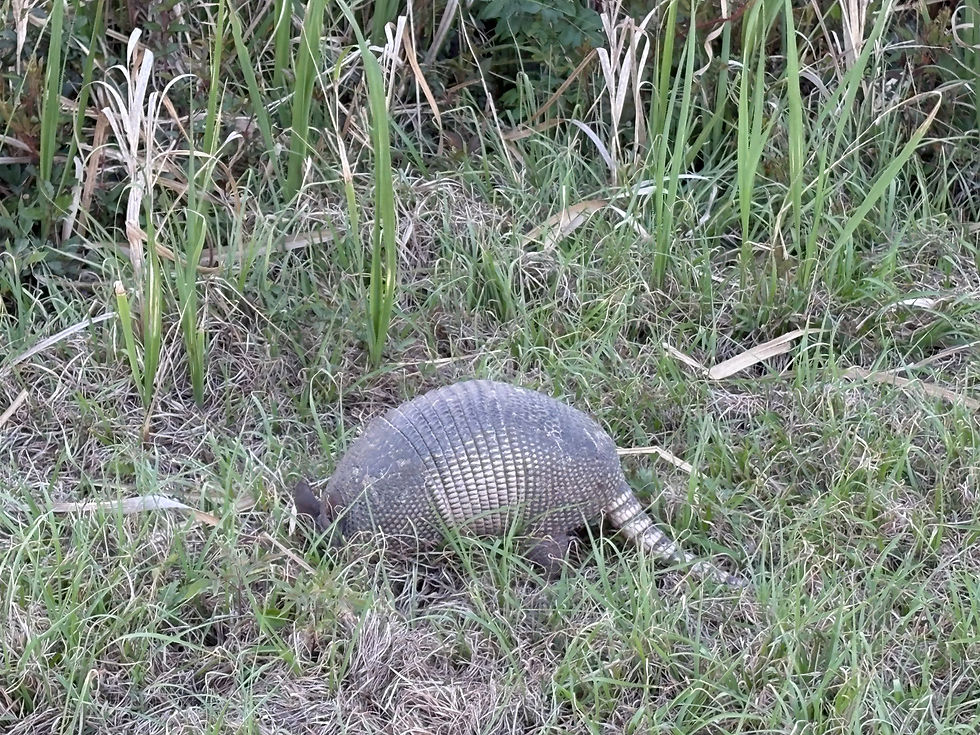
The Nine-banded Armadillo has arrived in the South Carolina ACE Basin with mixed reviews. Some people love their ambling gait and quiet nature, while others rally for their removal with reasons ranging from property damage to the diseases associated with them, namely leprosy.
I have run across the Nine-banded Armadillo on many occasions while hiking and they largely ignored me. They are not aggressive and, if approached, will flee.
Armadillos have poor eyesight, but a very powerful sense of smell that enables them to scent food sources or locate danger. Like their cousin, the anteater, their primary food source is insects, namely ants, termites, wasps, and larvae. They are also known for eating frogs, snakes and eggs.

Armadillos dig for their food and burrow for hiding. They prefer dark, shady areas with dense brush near woodlands or water sources. However, due to their adaptable natures do not be surprised to find them in culverts, cinderblocks and hollowed logs.
For several years we had a Nine-banded Armadillo living in our culvert pipe. We dubiously named him Frank. Frank occasionally wandered up our ramp to surprise us when we opened our front door.
Contrary to popular belief, Frank never dug a single hole in our yard. He did keep our ant hills to a minimum. We also had no issues with wasps or yellow jackets while he resided there. Our gardens thrived.
Once Frank moved on, our issues with grub worms and cut worms returned. Wasps and yellow jackets became more prevalent with increased interactions. Ant hills sprouted up across the property fairly quickly.
Of course, there will be many that dispute the observations; however, the disputes do not make the observations less factual.

Armadillos, when alerted, will do two things - flee or scent the air. Here the Armadillo is scenting the air.
Rising up on their rear feet gives them the advantage of scenting the direction of the threat and the ability to pivot with uncanny speed.
If no threat is perceived the Armadillo simply returns to foraging. The longer you are there, the less the Armadillo reacts to your presence.
While my opinion of the Nine-banded Armadillo may not be shared, I stand by it.
Armadillo Facts:
Armadillos are non-native to South Carolina and fall under the nuisance guidelines, due to their destructive nature.
Armadillos can be hunted on private lands year around with or without a license.
A license is required for hunting Armadillos on public lands.
Armadillos cannot be trapped and moved to different locations due to their impact on the environment.
For further laws and regulations concerning Armadillos, refer to the SCDNR website.


Comments